
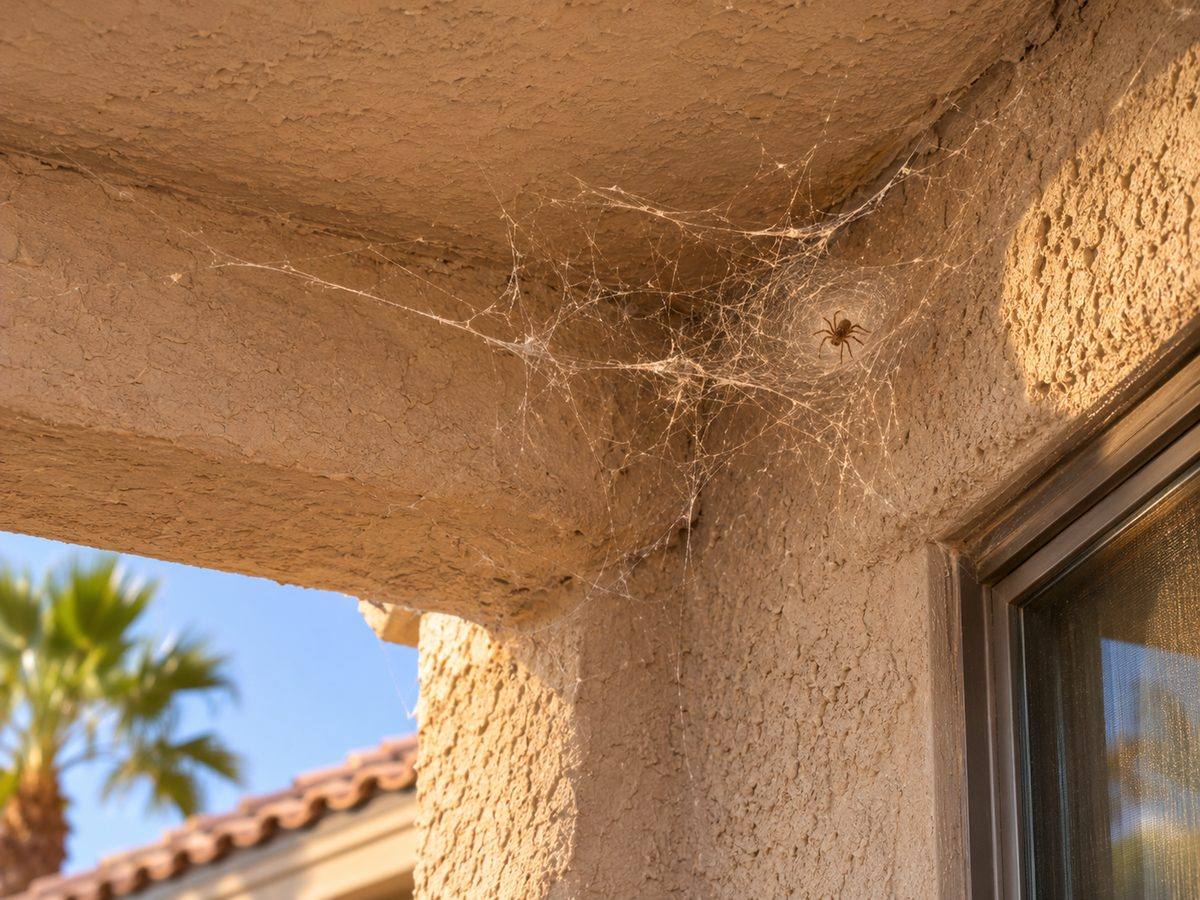
Why do the webs come back a week after I sweep them?
It is one of the most common complaints we hear: you get up on a ladder, clear every corner of the patio and the eaves, and a week later the same corners are webbed over again. That does not mean you did it wrong. It means one or more of these things is still true at your house:
- The spider survived. Knocking a web down does not always take the spider with it. If the spider is still there, it builds again in the same sheltered spot.
- One spider, many webs. The common house spider often leaves a web and builds a new one close by, so a single spider can put up a lot of webs in a short time. Extension entomologists say this habit causes homeowners a lot of frustration.
- New spiders keep arriving. Young spiders travel on air currents, drifting in on a strand of silk. University guidance on widow spiders says that is why control has to be repeated through the year, not done once.
- The egg sacs stayed behind. A sac left tucked in a corner can hatch hundreds of spiderlings. More on that below.
- The food is still coming. Spiders build where insects fly, fall or crawl into the web. Bright lights by the door, plants against the wall and clutter on the patio keep the insects coming, and the spiders stay for them.
A quick way to read what you have: a web covered in dust is usually an old web that no spider is using anymore, because a spider keeps its working web clean to catch food. A clean, fresh web in the same spot the morning after you cleared it means a spider is living right there.
Which spiders build the webs on a Las Vegas home?
Our common spiders ID guide covers every spider you are likely to see. For webs, four groups do nearly all the building, and the shape of the web tells you which one you have.
- Cobweb spiders, including the common house spider: irregular, sticky tangles with no neat pattern, built in the corners of rooms, at windows, along where walls meet, and in the upper corners of patios and garages. The spider usually hides in a corner, in a small silk tent or behind debris, and waits for insects to walk or fly in.
- Cellar spiders: the tiny-bodied, very long-legged spiders many people call daddy longlegs. Their fangs are generally too short to bite people. Their real problem is the loose, messy webs they leave in ceiling corners, closets, garages and under eaves, which catch dust and look dirty fast.
- Black widows: also a cobweb spider, with a tangled web of strong, rough, sticky silk. The web is usually low, within a few feet of the ground, but a widow can keep its retreat up in an eave and run a web well below it. In garages they build near doors, vents and other places insects pass. Our black widow guide lists the hiding spots to check before you reach.
- Orb weavers: the round, wheel-shaped webs built in rings, often strung from an eave to a shrub or beside a porch light. The spider rests in the middle or hides at the edge and feels for the vibration of an insect hitting the web. They live outdoors and are not a concern to people.
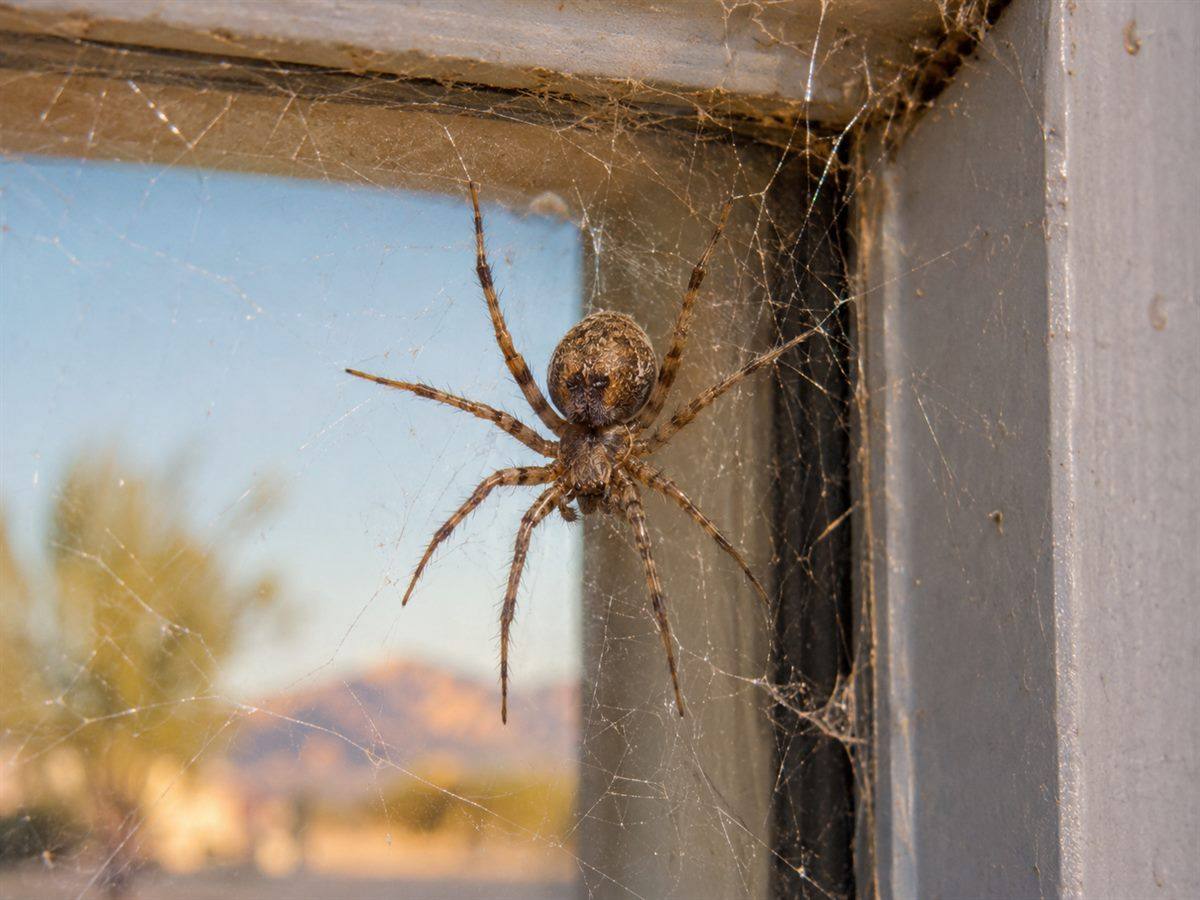
What draws web-building spiders to my house?
Spiders follow food, and their food is insects. A web is a trap, so a spider puts it where insects travel. Around a Las Vegas home, three things decide where those places are.
- Lights. Outdoor lights draw insects at night, and spiders follow the insects. That is why the corner above the porch light, the garage coach lights and the patio fixtures are often the first to web up again. Our article on porch lights and pests goes further into the lights themselves.
- Sheltered corners. Web builders favor protected corners: the angle where a stucco wall meets the eave, the underside of a covered patio, the frame of a window, the corners of a garage. Stucco ceilings and deep eaves give them plenty of those.
- Insects nearby. Plants pressed against the house, leaf litter and trash along the foundation, irrigation and outdoor clutter all hold insects close to the walls. Crickets are a big part of the picture here. Crickets are a major food source for scorpions and spiders. Reducing crickets helps reduce the pests that hunt them. If you hear crickets at night, read our post on Jerusalem and camel crickets.
So when the same three corners web over again and again, look at what is near them. Usually there is a light, a plant or a pile of stored things close by that is feeding the spiders. If your trouble spot is the patio or balcony, our article on spiders on patios and balconies walks through that space.
What are the little balls in the webs?
Those small, papery balls hanging in an old web are usually egg sacs, and they are one reason a corner you cleaned can fill with tiny spiders later on.
- Common house spider: brown, oval sacs with a tough, papery cover, about a quarter inch across. Each one holds roughly 140 to 380 eggs, and one female can make twelve or more sacs in her life.
- Black widow: tough sacs about half an inch long with a covering that is hard to tear. A single sac usually holds about 300 eggs, and one female can make more than ten sacs from a single mating.
That is why sweeping a web down and leaving the sac stuck in the corner, or knocking it into the rock bed below, does not finish the job. Take the sac out with the web. If you see an egg sac in a low, sheltered web near the ground, treat it as a possible black widow and wear gloves.
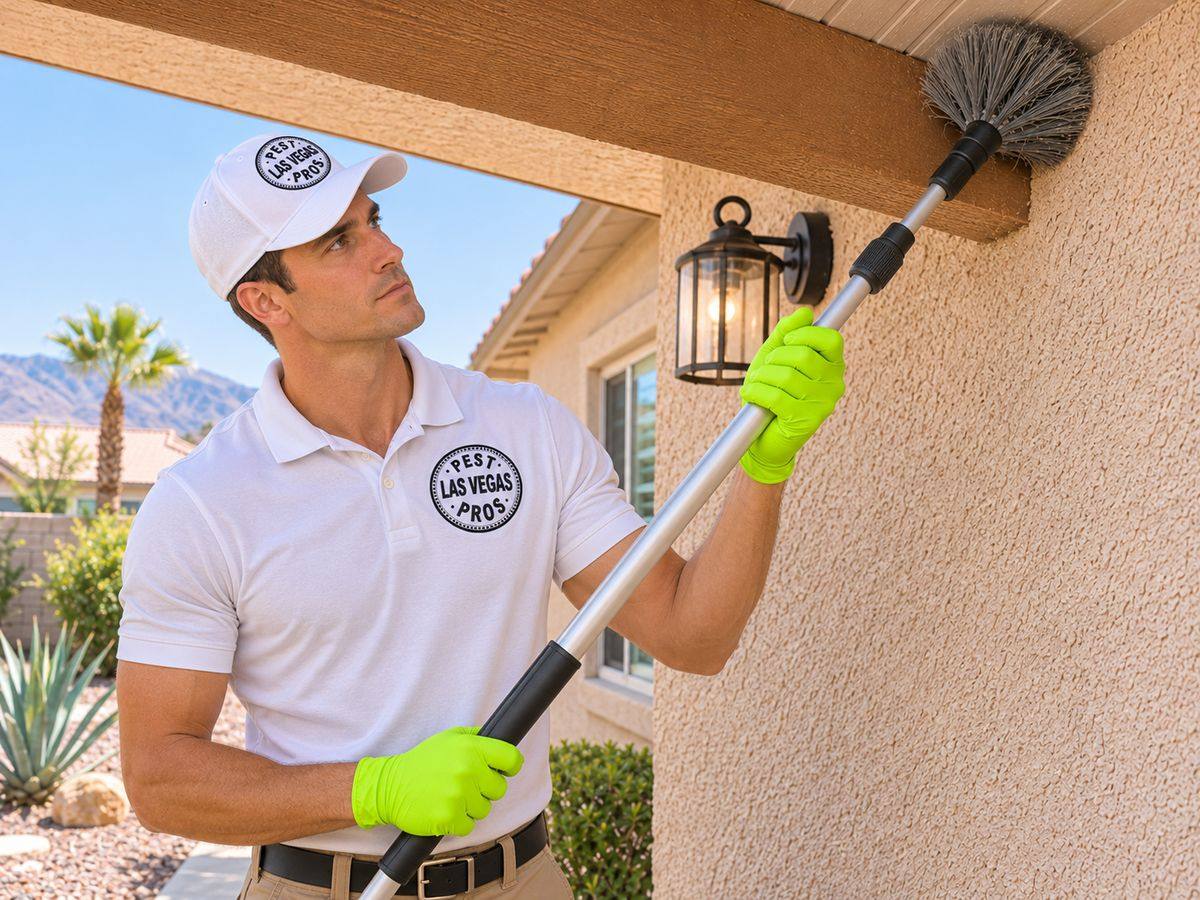
What can I do between visits to keep the webs down?
University guidance is plain on this: spraying for spiders alone gives only temporary results unless housekeeping goes with it. The routine below is what keeps corners clean between visits. None of it is complicated.
- Vacuum indoors. Vacuum the spider and the web together, egg sacs included, in room corners, windows, closets and storage areas. A spider's soft body usually does not survive the trip through the hose.
- Broom or hose outdoors. Clear webs from the eaves, patio ceiling and window frames with a long broom or a strong spray from the garden hose. Do it regularly, not once a season.
- Wear gloves. Wear gloves when you clean garages and storage areas, and look before you reach under patio chairs, grill covers, valve boxes and the lips of pots.
- Move or aim the lights. Where you can, keep light fixtures off the house and away from windows and doors, and switch off lights you do not need.
- Clear the floor. Keep boxes off the garage floor and away from walls, and tape them shut. Keep the strip along the foundation free of trash, leaf litter and heavy plant growth.
- Trim back. Trim shrubs and vines so they do not touch the walls or roofline. Plants touching the house give spiders a bridge and insects a hiding place.
- Close the gaps. Cracks in the foundation, gaps around doors and windows, and torn screens let in spiders and the insects they eat. Door sweeps, screen repair, caulk and weather-stripping help. We recommend the fix; we do not do it. Pest Pros does not seal, patch or repair homes. For bigger work, call a handyman.
If you find a spider and are worried about a bite, we never diagnose a bite. See a medical professional.
How Pest Pros does it
Spiders and their webs are covered by our general pest service, at the same price. General service is our core service and covers more than 100 common pests. Every visit treats the full property, inside and out. Our technicians target whatever you are seeing, at the same price, so tell us which corners keep webbing up and we will focus there.
The work follows what we say about each spider. For cellar spiders and other nuisance web spiders, we remove webs, treat corners and reduce the insects they feed on. Black widows hide in protected corners and clutter, so we remove webs and treat where they rebuild. Because spiders follow insects, we treat for the insects too, crickets included. Licensed technicians apply every product exactly as its label directs. Keep people and pets off treated surfaces until the product is dry; once it is dry, use the home as usual.
Why does the schedule matter for webs? Las Vegas heat, dry air and sun break products down fast, and new spiders keep drifting in. Every 60 days is the schedule we recommend for the desert. Once the home is under control, most customers choose exterior service and have the inside treated once or twice a year. On each visit we also point out the lights, plants, clutter and openings that keep feeding the spiders. Our guide to what general service covers explains the rest.
The first visit is $120. There is no obligation to continue. Customers who continue pay $80 every 60 days. If you ask for monthly service, it is $50 a month. A one-time service is $120. We stand behind an infestation warranty: if pests return between visits, we return too, at no charge. We ask for 7 days after a treatment before judging results. There is no contract and no cancellation fee. Every price is on our pricing page, and here is how to get ready for a general service visit.
Common questions
Does a dusty web mean I have spiders right now?
Should I remove the egg sacs?
Are the webs on my eaves dangerous?
Are spiders and webs covered by general service?
Do I have to sign up for monthly service?
Sources: UC IPM Pest Notes: Spiders (Pub 7442) · UC IPM Pest Notes: Widow Spiders and Their Relatives · Penn State Extension: Common House Spider. Facts are summarized in our own words. Prices, service and warranty come only from Pest Pros.