
Why do scorpions glow under a blacklight?
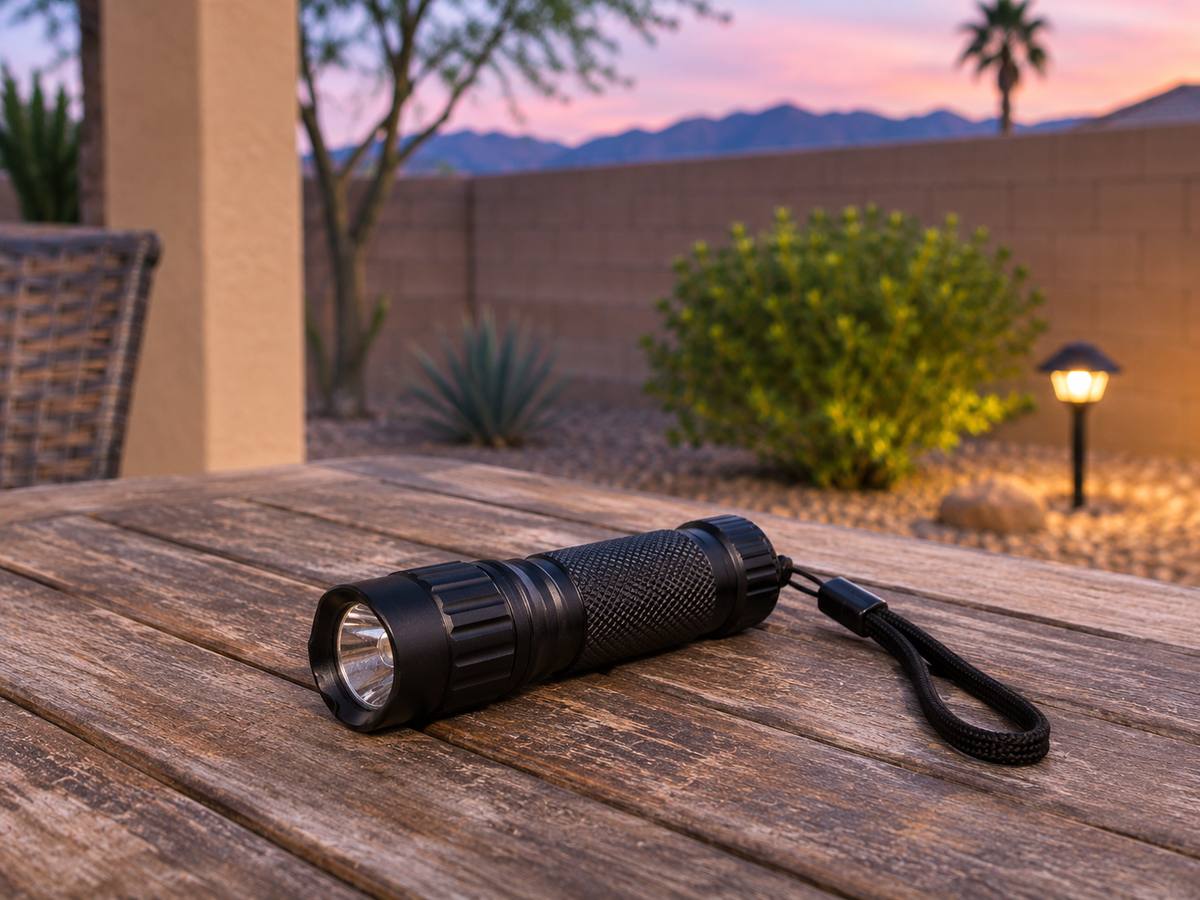
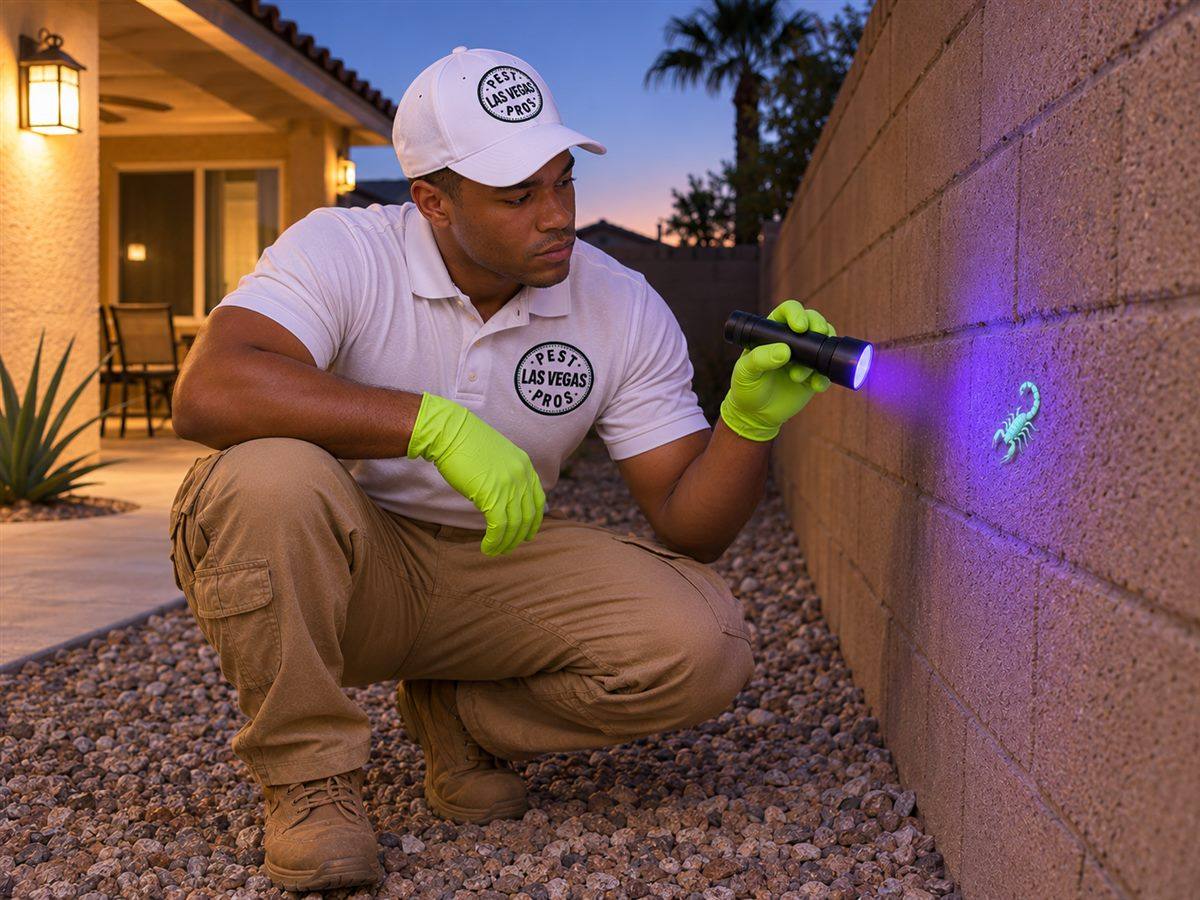
A scorpion's outer shell holds compounds that soak up ultraviolet light and give it back as visible light. Under a UV flashlight the whole animal lights up a bright blue, almost cyan, while the wall, the gravel and the dirt around it stay dark. Researchers use this to find scorpions in the desert at night, and university extension guides from California and Arizona suggest the same tool to homeowners: a portable black light makes scorpions easy to spot and remove.
A few things about the glow are worth knowing before you go out:
- Bigger and older glows brighter. The glow comes from the hardened shell, and it gets stronger as the shell ages and hardens. Small, young scorpions and ones that have just shed their skin glow faintly, so look twice at anything dim.
- Other things glow too. Bits of lint, paper and some plastics can shine under UV. A scorpion has a shape you will recognize right away: eight legs, two pincers and a tail curled over or trailing behind.
In the Las Vegas valley, the one most homeowners find is the bark scorpion, a slender scorpion that climbs block walls and stucco and can get into a home through a crack about 1/16 inch wide. If you want help telling it apart from the others, our guide on how to identify a bark scorpion walks through it.
When should you look?
Scorpions hunt at night and hide during the day, so a daytime check with a blacklight shows you almost nothing. Go out after full dark, about an hour after sunset, when the walls have started to give off the day's heat and scorpions come out to hunt. University of Arizona extension guidance puts the best window at roughly 8 to 11 p.m. in summer.
The time of year matters as much as the time of night. Las Vegas pests follow heat and water. Spring wakes scorpions up. Summer heat drives scorpions and crickets toward cool, damp places, often indoors. The late-summer monsoon storms bring a spike in crickets, and the scorpions follow them. So the months that teach you the most are late spring through the end of monsoon season, and the nights right after a summer storm are often the busiest of all.
One check tells you something. A few checks tell you much more. Try the same route once a week for a month in the warm season, at about the same time each night, and write down what you see. A pattern of one here and there reads very differently from three or four on the same wall every night.
Where should you look around a Las Vegas home?
By day, scorpions tuck into tight, shaded spots: under rocks, boards, pavers and debris, in cracks in block walls, under tree bark and in palm trunks, in stacked wood, and inside walls and attics. At night they come out to hunt along the edges where insects travel. That makes a typical Las Vegas lot easy to walk in a set loop. Start at one corner and work your way around:
- Block walls, both sides if you can. Shine the light along the base where the wall meets the gravel, then slowly up the face and along the top cap. Bark scorpions climb block and stucco easily, so many of them are found well off the ground.
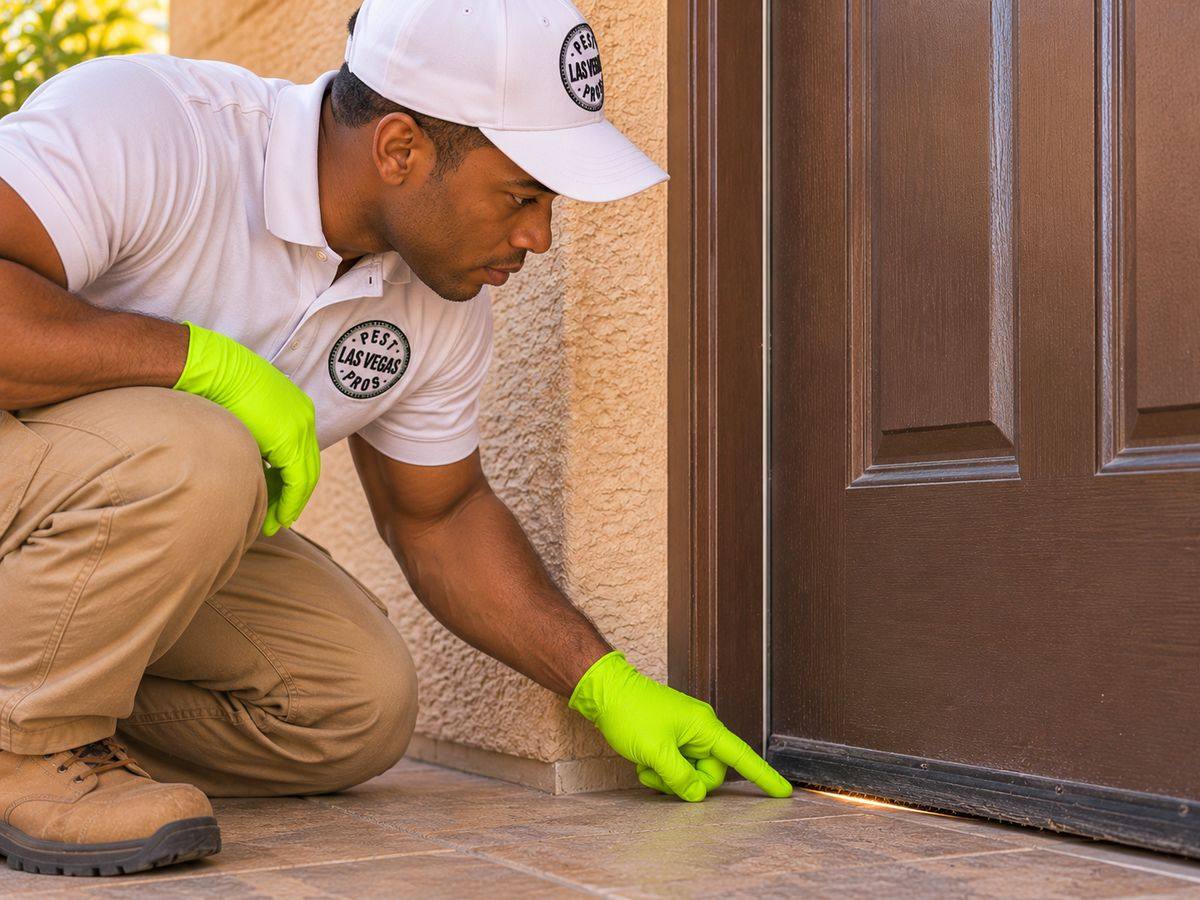
- The outside walls of the house. Run the beam along the foundation line, up the stucco and around windows, the garage door and every exterior door. Pay attention to the bottom corners of doors.
- Desert landscaping. Rock beds, landscape borders, pavers and the edges of artificial turf. Look at the gaps between rocks rather than across the top of the gravel.
- Water and shade. Pool equipment, around the pool deck, irrigation valve boxes, drip lines, potted plants and anywhere the ground stays damp. Water brings crickets, and crickets bring scorpions.
- Things that sit still. Woodpiles, stored items against the wall, patio furniture, grill covers and the cushions people leave outside.
- Inside, with the lights off. Baseboards, the bathroom and kitchen floors, closets, the garage and the laundry room. Check walls and ceilings too.
Move the light slowly. A quick sweep misses dim, young scorpions and the ones sitting in a crack with only a pincer showing. Note where each one is. Scorpions that keep showing up in the same spot are telling you where they hide and where they travel, and that is useful for your technician.
What does your count tell you?
The reason to count is simple: the number tells us where to start. Our rule is about the scorpions you find over a year.
- Fewer than 10 a year: you can start with general service. It kills scorpions, lowers the population and may give all the control you need. General service carries a full warranty for general pests, not for scorpions.
- More than 10 a year: start the scorpion program, $150 for the first treatment, then $50 a month.
A blacklight check usually turns up more scorpions than you would ever meet by chance.
Where you find them matters too. Several on the back wall every night, or any found inside the house, point to a population that is living on the property, not a single visitor. One or two along the far side of the yard after a storm is a different picture. Our answer on general service or the scorpion program goes through the full rule.
How do you handle what you find without getting stung?
Most stings happen when someone touches a scorpion they did not see: a bare foot, a hand into a glove or a shoe, a hand on the wall or under a cushion. A night check is the moment you are most likely to be close to one, so set yourself up before you start:
- Wear closed shoes and long pants. Never walk the yard barefoot or in sandals at night.
- Keep your hands off walls, rocks and furniture. Look with the light, not with your hands. Wear gloves when you move anything, and shake gloves and shoes out before you put them on.
- Leave children and pets inside while you check.
- Never pick a scorpion up by hand. Do not touch it; take a photo from a distance.
If it is on a wall or a ceiling you cannot reach, leave it, keep people away from that spot and take a photo from a comfortable distance.
If anyone is stung, call a medical professional or Poison Control. We are pest people, not doctors, and we never guess about a sting. Our post on scorpion stings and what to know covers when to call for help.
A blacklight check is a good way to learn what you have, and Arizona extension research finds that repeated night collections can bring local numbers down. It does not reach the scorpions hiding in walls, under the rock bed and next door. For that, the next step is treatment, along with closing the gaps they use to get in. Our guide to keeping scorpions out covers door sweeps, weatherstripping and the gaps a bark scorpion can use, and scorpion season in Las Vegas explains when activity peaks.
How Pest Pros does it
When you call, we start with you, not the price. We ask what you have seen in the last 30 days, where, and how many in a year. Your blacklight notes make that conversation quick. Then we explain which start fits your home.
Scorpions are a perimeter program. Crickets are a major food source for scorpions and spiders, and reducing crickets helps reduce the pests that hunt them. That is why our general service treats crickets as part of every visit. General service is $120 for the first visit, then $80 every 60 days if you continue. There is no obligation to continue.
The scorpion program is $150 for the first treatment, then $50 a month. The scorpion warranty is full while the home has been treated in the last 30 days and stays on a 30-day schedule. If scorpions show up 7 or more days after a monthly treatment, we come back between visits at no charge. We ask every customer for 7 days before judging results, because products take time to flush pests out and reach full effect.
We tell scorpion customers up front that there is a step down: after 3 monthly treatments you may move to $80 every 60 days, which covers general pests and scorpions together. At 60 days there is no full scorpion warranty. Licensed technicians apply every product exactly as its label directs. Once treated areas are dry, your family and pets can use them normally.
On every visit we show you the openings worth closing, like a worn weatherstrip or a gap under the garage door, and recommend simple fixes you can do yourself. Pest Pros does not seal, patch or repair homes. There is no contract and no cancellation fee. Every price is on our pricing page, and the program details are on our scorpion control page.
Common questions
What kind of blacklight works for finding scorpions?
I checked and found nothing. Am I in the clear?
I found several on one night. Do I need the scorpion program?
Can I get rid of scorpions just by hunting them with a blacklight?
Do I have to sign up for monthly service?
Sources: UC IPM: Scorpions · University of Arizona Cooperative Extension: Scorpions of the Desert Southwest United States (AZ1768) · Research paper on scorpion fluorescence (arXiv 2108.04177). Facts are summarized in our own words. Prices, service and warranty come only from Pest Pros.