What do pigeon droppings damage on a Las Vegas home?
One pigeon passing over the yard is not a problem. A flock that roosts on the same ridge, ledge or patio cover every night is. Pigeons go back to the same spots again and again, so their droppings pile up in a few places instead of spreading thin. The University of California's pest management program notes that pigeon droppings deface buildings and speed up their wear, and can kill plants underneath a roost. Here is where Las Vegas homeowners usually see it first:
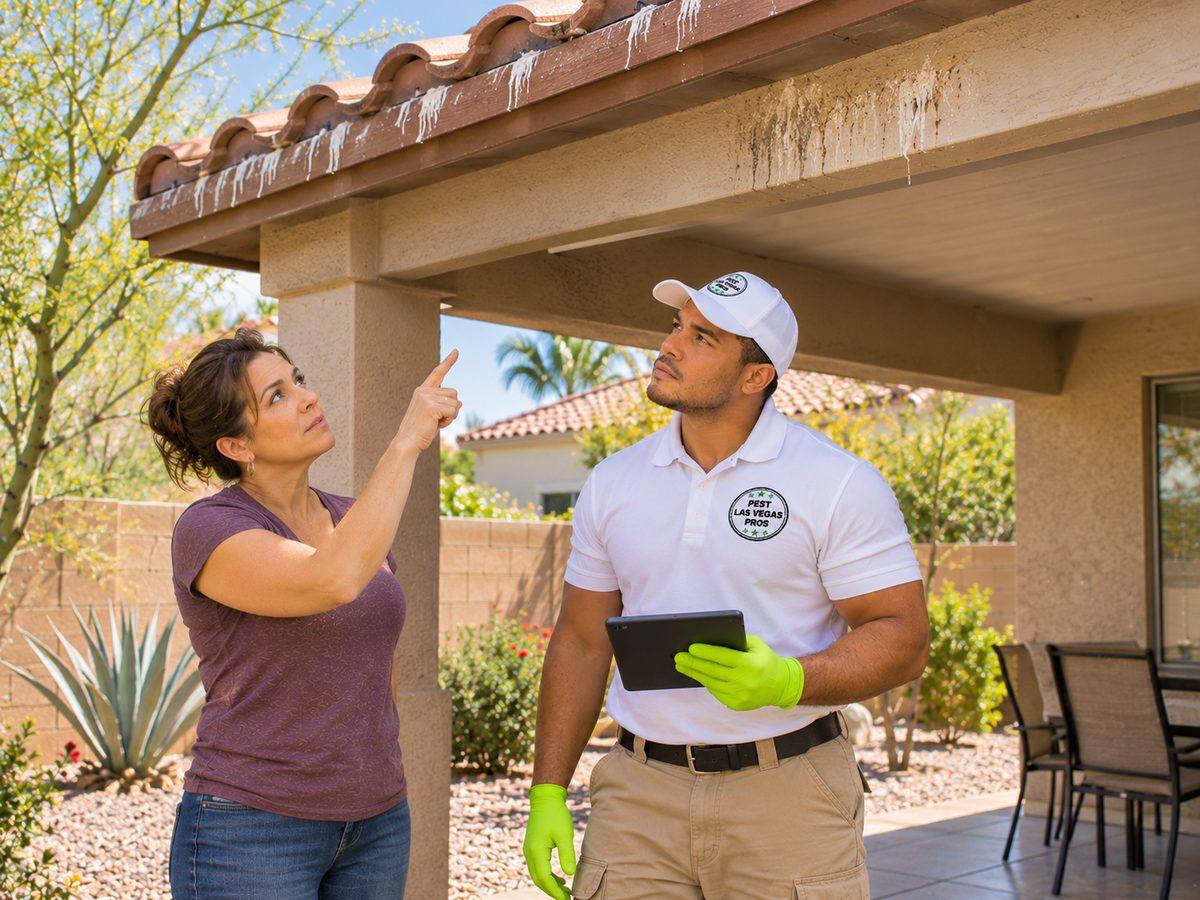
- Roof tile: white and gray streaks running down concrete and clay tile from the ridge and the gaps under the first row of tile. The droppings hold moisture against the surface and leave stains that do not rinse off easily, especially after months of build-up baked on by the desert sun.
- Stucco and block walls: streaks under ledges, pop-outs, parapets and light fixtures where birds perch. Stucco is porous, so the stain soaks in.
- Patios and patio covers: the edge of an aluminum or wood patio cover, a pergola beam or a covered walkway is a favorite perch. What lands below ends up on your patio furniture, pavers, pool deck and grill.
- Cars: a car parked under a roost line or in a driveway below the roof edge gets hit every day. Droppings left sitting on paint can stain the finish, and the Las Vegas heat bakes them on fast, so wash them off soon rather than letting them sit.
- Solar panels: droppings on the glass block sunlight, and the space under the panels is one of the most common pigeon nest spots in the valley. Shaded all day and out of the wind, it fills up with droppings, feathers and old nests. We cover that in detail in pigeons under solar panels.
The pattern of the mess tells you where the birds spend their time. Heavy streaks under one section of roof, or a pile on one corner of the patio, almost always means a perch or nest directly above it.

What happens to gutters, drains and AC units?
Droppings are only part of what a roosting flock leaves behind. Pigeons build loose nests of twigs, grass, feathers and debris, and they reuse the same nest site over and over, so the material stacks up. Over a season, droppings, feathers and old nest material collect in the places water and air are supposed to move:
- Gutters and downspouts: nesting debris and droppings pack into gutters and the tops of downspouts. When monsoon storms finally bring heavy rain, water backs up and spills over the edge instead of draining.
- Roof drains and scuppers: flat roofs and parapet walls drain through small openings that clog easily with feathers and nest material.
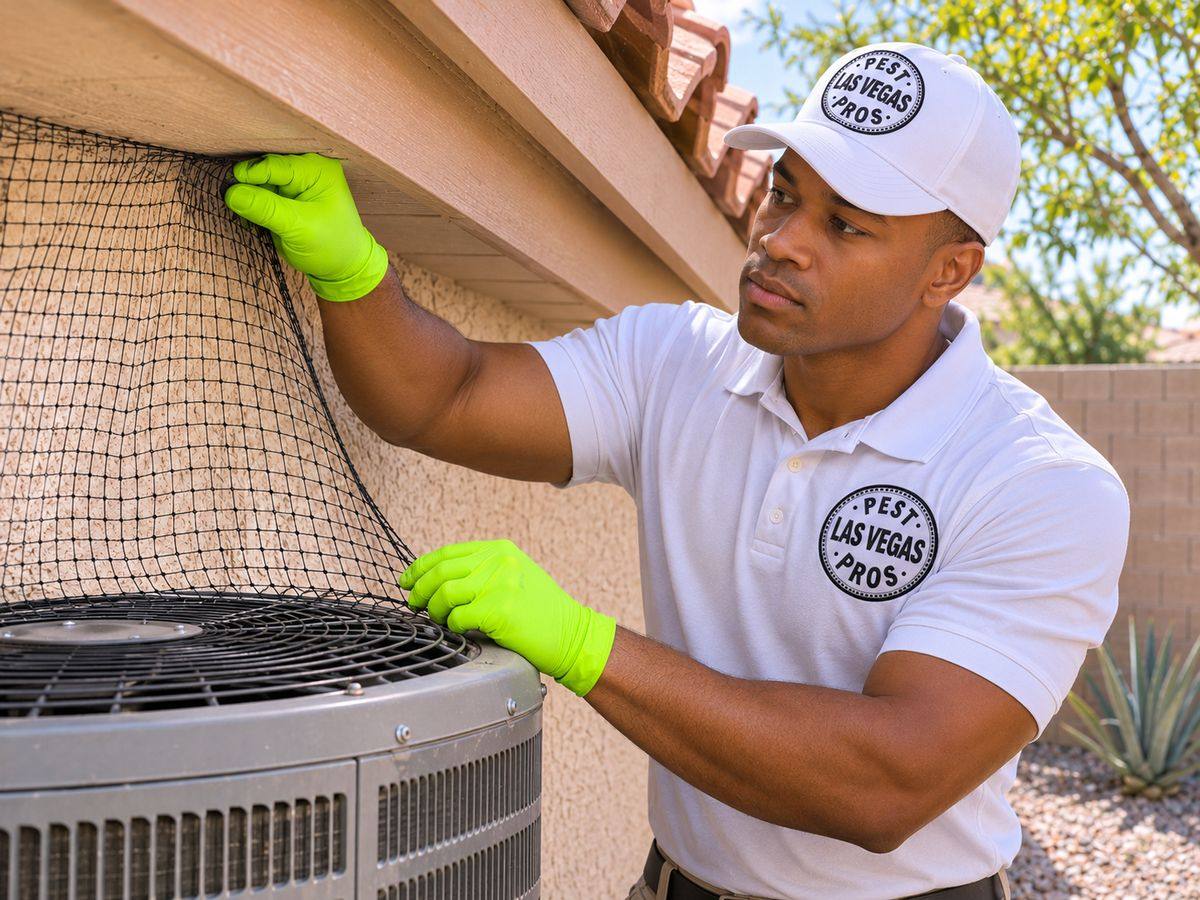
- AC units and equipment: the gap between a rooftop or side-yard AC unit and the wall, or the space under an equipment stand, gives pigeons shade and shelter. Droppings and nest material pile up around the unit, on the coil fins and in the gaps around it.
- Vents and openings: any opening along the roofline that leads to shade can hold a nest. Shade is what pigeons look for in a Las Vegas summer.
None of this happens overnight, and that is the problem: by the time a homeowner notices water spilling over a gutter or a smell near the AC, the nest site has usually been in use for months.
Are dried pigeon droppings a health concern?
Public health agencies say the main concern is not touching a fresh dropping, it is breathing dust from old, dried droppings that have been stirred up. According to the CDC, the fungus that causes histoplasmosis grows in soil and material that contain large amounts of bird or bat droppings, and people can breathe in its spores when that material is disturbed. The CDC also links the fungus that causes cryptococcosis to soil and to dried pigeon droppings.
The CDC notes that most people who breathe in these spores do not get sick, and that people with weakened immune systems are more likely to have serious illness. NIOSH, the federal agency for worker safety, treats large accumulations of bird droppings as a job for people with proper protective gear, because cleanup is exactly the activity that puts the dust in the air.
We are a pest control company, not a medical provider, and this article is not medical advice. If you have symptoms or a health concern after being around droppings, or someone in the home has a weakened immune system, talk to a medical professional.
How should you handle a small cleanup?
A light mess on a patio table or a few droppings on a walkway is something most homeowners clean up themselves. Keep the dust down and follow the CDC and NIOSH guidance.
Leave the big jobs alone: a pile built up over months under solar panels, an attic or eave space full of old nest material, or anything that means climbing onto the roof. Those are the places where the dust and the fall risk are both real.
Before you clean, take a few photos of the droppings and where they are. Those photos show us where the birds are sitting, and they help with your estimate.
Why does stopping the roost come first?
Cleaning without changing the roost is a temporary fix. Pigeons return to the same spot day after day, and a cleared nest site just leaves a clean spot for the next nest, often within days. The droppings are the symptom. The perch and the shade pocket above them are the cause.
In the Las Vegas summer, water and shade decide where pigeons settle. They drink from pools, spas, fountains and dripping irrigation, and they roost in the deepest shade and shelter they can find: under solar panels, under the first row of roof tile, behind AC units, on patio cover beams and in eave gaps. So the control work targets those pockets, not necessarily the whole roof.
Things you can do to make your home less appealing:
- Do not feed pigeons, even a little, and keep bird seed off the ground.
- Bring pet food in and clean up fallen fruit.
- Fix drips from irrigation, hose bibs and AC condensate lines.
Cutting off food and water will not move a nesting flock on its own, but it helps installed work hold and keeps new birds from picking your roof. For the full picture on why pigeons choose a roof, see pigeons on your Las Vegas roof.
How Pest Pros does it
Pigeon work starts with a free digital estimate. Send us the service address, an email, a short description of what you are seeing, and photos of the droppings, nests and the spots where the birds sit. We look at the roof on Google Maps along with your photos and send back fast, free quotes. Larger jobs are itemized, then bundled, so more work earns a bigger bundle discount.
Every pigeon job starts at $300, one story or two. That includes 15 feet of spike, 30 minutes of cleanup and a 2-year warranty on the work. Extra spike is $10 per foot beyond the first 15 feet. Extra cleanup is $50 per 30 minutes beyond the first 30. Solar-panel work is priced by the foot: as low as $6 a foot on a one-story home with flat tile, up to $8 a foot on a two-story home with rounded tile. We do not work on 3-story roofs.
Cleanup is done where it is marked on your estimate, so you know which areas are included before work starts. Our installation method is cut-and-tuck: spikes where pigeons perch, screen where they shelter, fitted to the shade pockets they use. We take before-and-after photos of the work, so you can see exactly what was done.
There is no contract. Pigeon work is a single job, not a monthly plan. See every price on our pricing page and the full service on our pigeon control page.
Common questions
Can pigeon droppings damage my roof tile?
Should I clean the droppings before you come out?
Is cleanup included in pigeon work?
Are pigeon droppings dangerous to my family?
Do I have to sign up for ongoing service?
Sources: UC IPM Pest Notes: Pigeons · CDC: Histoplasmosis · CDC: Cryptococcosis · NIOSH: Histoplasmosis, Protecting Workers at Risk. Facts are summarized in our own words. Prices, service and warranty come only from Pest Pros.