
How small a gap does each pest need?
A Las Vegas house is mostly stucco over block or framing, sitting on a concrete slab, with a tile or shingle roof. That shell is tough, but every place where two materials meet, or where something passes through the wall, leaves a seam. Pests do not need a hole you would notice. They need a seam that lines up with where they already travel, and the size that matters is different for each one. University extension researchers give these numbers:
- Bark scorpion: a crack about 1/16 inch wide is enough. It also climbs slump block walls and stucco, so its gaps can be anywhere from the slab to the eaves.
- Cockroaches: German cockroaches hide in cracks about 1/16 inch wide. The large outdoor roaches, like the American cockroach, come in through gaps under doors, along pipes and conduits, through missing screens and through damaged pipes or drains.
- House mouse: can squeeze under a gap about 1/4 inch tall and through an opening about 3/8 inch wide. A dime-sized gap is plenty.
- Rats: a young rat can get under a door with a 1/2-inch gap. Extension guidance is to close every hole larger than 1/4 inch to keep out both rats and mice.
The practical lesson: if you can slide a pencil under it, a mouse can probably use it. If you can see daylight through it, a scorpion can. You will never close every seam in a house, and you do not have to. Close the ones on the routes pests already use. The places you find pests, droppings or dead insects inside usually point to the nearest door they used.
Where do pests get in at ground level?
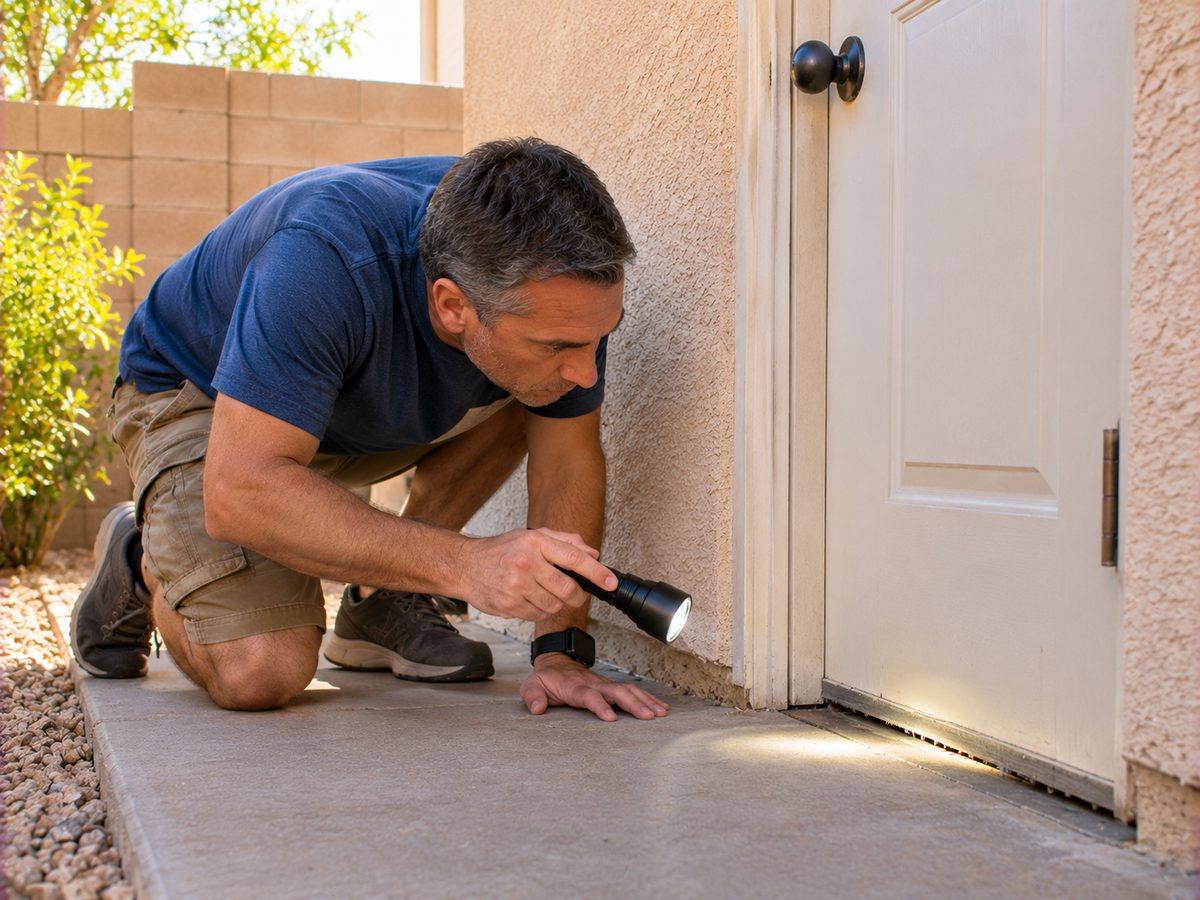
Start low. Mice and most crawling pests come in at ground level, and those gaps are the easiest for you to check and close. Walk the outside of the house once in daylight with a flashlight, then check the same spots from inside after dark with the room lights off.
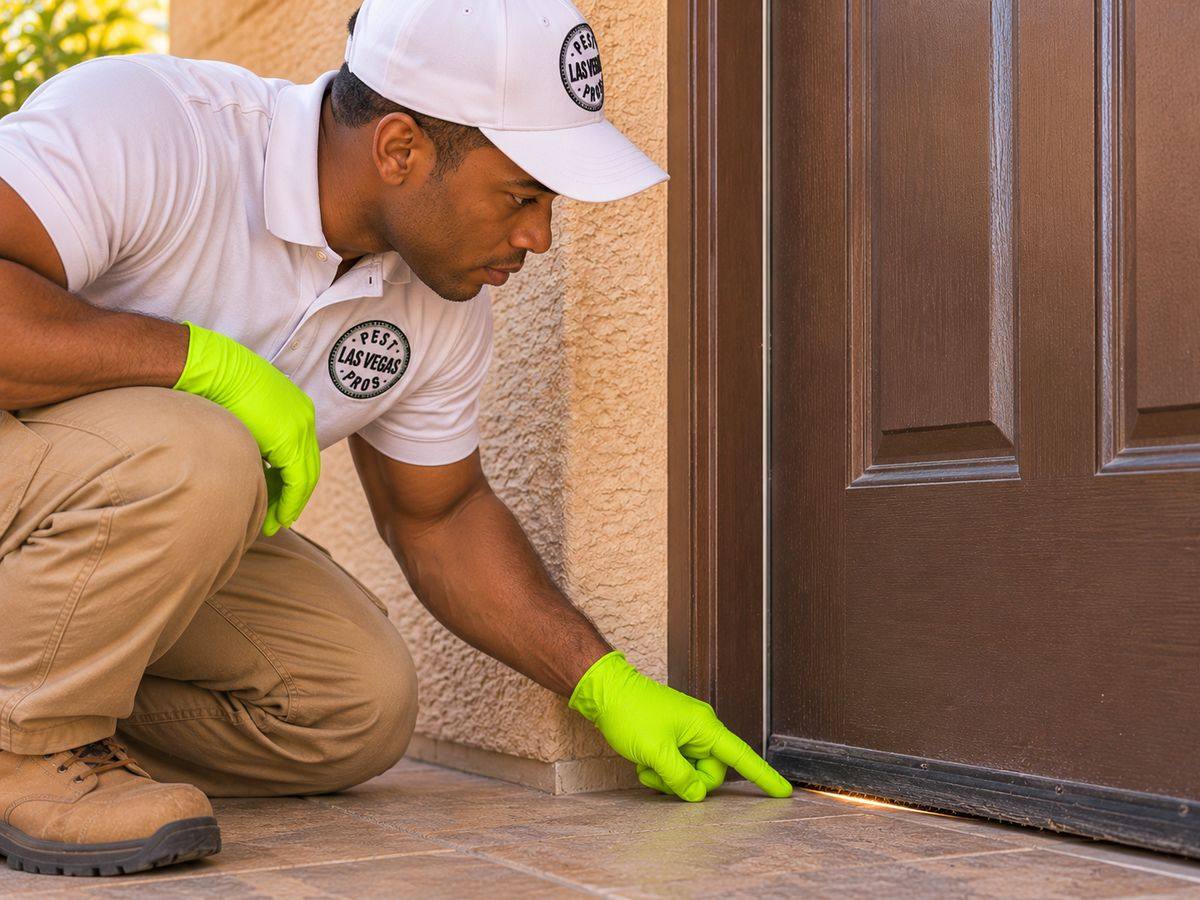
- Exterior doors and thresholds: lie down and look under each door. Light under the door, a sweep that is curled or torn, or a threshold that has pulled loose from the slab is a way in. Our guide to keeping scorpions out covers door sweeps and weather-stripping in detail.
- Double doors and patio sliders: on double doors, check the seam where the two doors meet, top to bottom, not just the bottom edge. On sliders, check the track and the vertical seal where the panels overlap.
- The garage door: in Las Vegas the rubber seal along the bottom of the garage door is the most common way in for mice. Look for cracking, flattening and gaps at the two bottom corners where the door meets the frame. Do not forget the side door into the garage and the door from the garage into the house.
- The weep screed: most Las Vegas homes have a metal strip where the stucco ends just above the slab or the soil. Look along it for cracks in the stucco above it, sections that have pulled away from the wall, and gaps where it meets pipes or the corners of the house.
- Pipe and line penetrations: the hose bibs, the gas line at the meter, the air conditioning line set where it enters the wall, the cable and phone lines, and the pool equipment lines. Look for old foam or caulk that has cracked, shrunk or been chewed.
What about the walls, vents and the roofline?
Climbers use the walls and the roof. Bark scorpions climb stucco and block. Roof rats climb palms, trees, vines and block walls and get into the attic at the roofline. Our guide to roof rats and mice in your attic explains how they travel. From the ground, with binoculars if you have them, check:
- Windows and screens: torn screens, screens that sit loose in the frame, and screens left off after cleaning. A screen that does not fit tightly lets insects walk around it.
- The dryer vent: the hood outside should have a flap or louvers that close when the dryer is off. A flap that is stuck open, broken or missing leaves an open duct into the laundry room.
- Other wall and foundation vents: bathroom and kitchen exhaust hoods, and any vent covers with torn or rusted screens.
- Attic and roof vents: gable vents and roof vents with missing or damaged screens. Extension guidance also calls for screening rooftop plumbing vent pipes larger than 2 inches across.
- Eaves and roof edges: gaps where the roof meets the wall, the open ends of tile rows at the eaves, and where a patio cover ties into the house.
- Bridges to the roof: tree limbs, palm fronds and vines touching the house. Extension guidance is to remove climbing plants from the walls and trim limbs back to at least 3 feet from the roof.
Note what you see from the ground and leave the roofline work to a handyman.
What should I use to close each gap?
The right material depends on what is getting in. A seal that stops a scorpion can be chewed through by a mouse in a night, so match the fix to the pest.
- For insects and scorpions: door sweeps that meet the threshold with no gap, weather-stripping around the door frames, caulk along cracks, around pipes and along the eaves, and screens that fit their frames tightly. These are the simple hardware-store fixes.
- For mice and rats: use what they cannot chew. Extension researchers list coarse steel wool, wire screen, sheet metal, and metal or concrete around pipes, vents and utility lines. They also note that rodents chew through plastic, rubber, vinyl, expanding foam, wood and caulk, so those alone do not hold a rodent gap. Steel wool works as a temporary plug but can rust over time. Lightweight chicken wire has openings too big to stop a rat.
- For doors that get chewed: the bottom edge of a door can be covered with sheet metal.
- For vents: vent covers and screens should be sturdy metal mesh, in good repair, not plastic screening.
A common mistake in desert homes is a can of expanding foam around the air conditioning lines. It closes the gap for insects, but a mouse can chew right through it. Where rodents are part of the picture, back the foam or caulk with metal.
What can I do myself, and what needs a handyman?
Closing up a home keeps pests out, and we say so on every visit. Gaps under doors, torn screens, open holes and cracks let in insects, rodents and other animals. A home that is closed up needs less treatment and stays clean longer. Most of the list above is an afternoon with a few hardware-store items:
- Usually a homeowner job: door sweeps, weather-stripping, screen repair, caulk along small cracks and around pipes, and trimming plants back from the walls.
- Usually a handyman job: cracked stucco and a weep screed that has pulled away, a door that no longer fits its frame, a broken dryer vent hood, a worn garage door bottom seal, metal patches over larger holes, vent screens up high, and anything at the roofline. This is carpentry, texture and paint, sometimes with licenses, codes and permits.
We recommend the fix; we do not do it. Pest Pros does not seal, patch or repair homes, and never charges for it. For bigger work, call a handyman. If you have just moved in, our new home pest checklist is a good first walk-around before you start.
When should I not seal a gap yet?
When rodents are active. This is the one exception to the advice above, and it matters. Never close up a home while rodents are still active. A rodent sealed inside cannot get out for water. Trapped and thirsty, it chews through water pipes and electrical lines, and the damage can run to tens of thousands of dollars. Rodents that die inside also bring smell, flies and maggots.
So if you have fresh droppings, scratching in the ceiling or chewed packages, put the sealing list on hold. Close up only after the population is confirmed gone, and use a handyman for it. Our guide to house mice in Las Vegas explains what to do while the rodent program runs, and our post on rodent droppings shows how to tell fresh activity from old. Insect and scorpion gaps can be closed anytime.
How Pest Pros does it
On every visit your technician looks at the same places this guide covers and shows you the openings worth closing. We recommend the fix; you or your handyman does it. On the American cockroach, for example, we tell you: "This is a large sewer roach. We find where it is coming in, treat it, and show you the gaps worth closing."
General service is right for any home, with pests or without. Every visit treats the full property, inside and out, for more than 100 common pests. The first visit is $120. There is no obligation to continue, no contract and no cancellation fee. Customers who continue pay $80 every 60 days, the schedule we recommend; a customer who asks for monthly service can have it at $50 a month. Our warranty words: "If pests return between visits, we return too - at no charge." Every price is on our pricing page.
If rodents are active, the rodent program comes first. It is baiting, not trapping and not sealing. The first visit is $200: we inspect the property and install 3 bait stations. We come back every 30 days for $50 to check, refill and move the stations, $300 in all over 3 visits. Our bait stations make sealing much less necessary: $80 every 60 days for pest and rodent control together can cost less over years than one sealing job.
Common questions
Will Pest Pros seal my home for me?
Is expanding foam good enough around pipes?
I have mice. Should I seal the holes now?
Which gap should I close first?
If I seal everything, do I still need service?
Sources: UC IPM Pest Notes: House Mouse · UC IPM Pest Notes: Rats · UC IPM Pest Notes: Scorpions · UC IPM Pest Notes: Cockroaches. Facts are summarized in our own words. Prices, service and warranty come only from Pest Pros.