
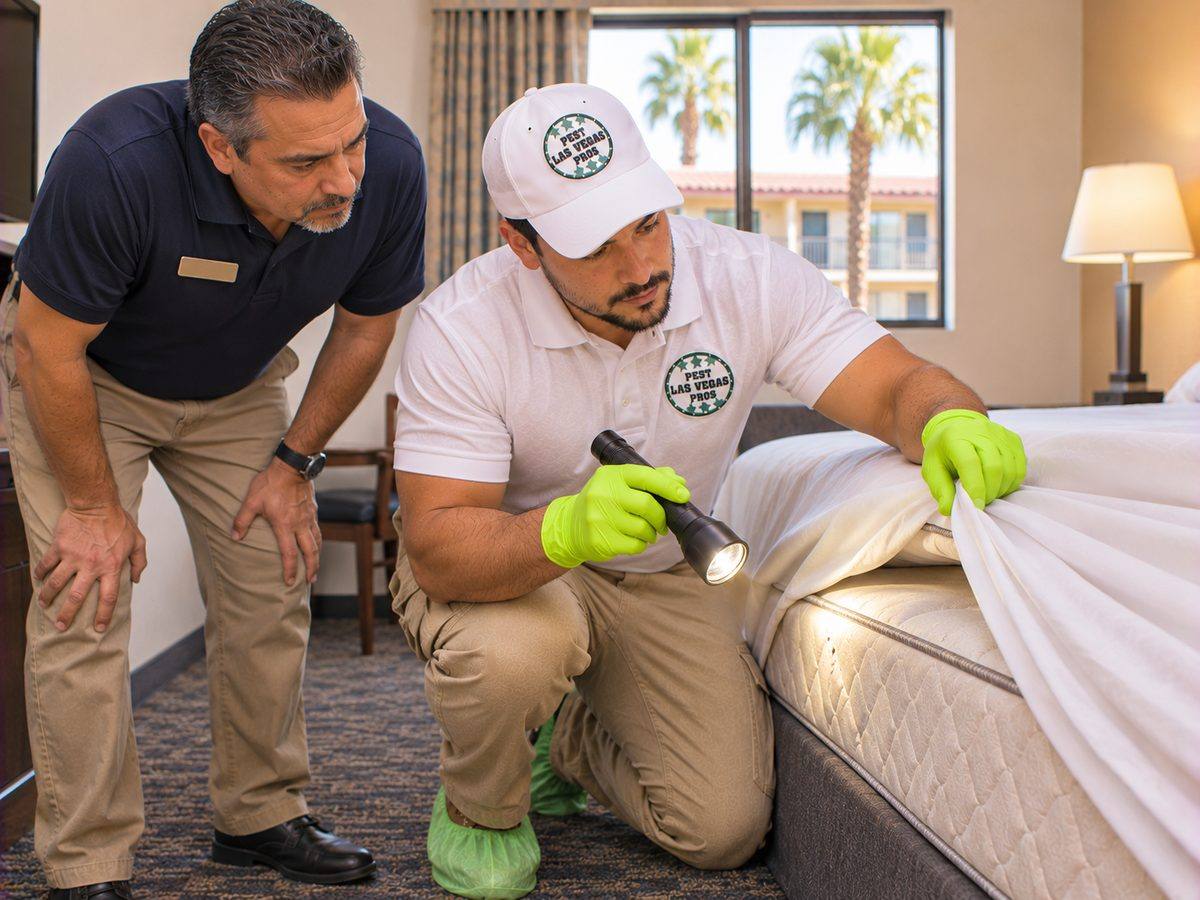
How do bed bugs get in, and what can housekeeping spot at turnover?
Bed bugs do not come from dirt. They come from people. A bed bug hides in a suitcase seam, a backpack or a fold of clothing, rides along to the next room, and walks out at night looking for a meal. A city that hosts visitors from all over the world every week will always see bed bugs arrive. A spotless motel can get them from one guest, and a five-star suite is no exception. What matters is how fast you find them.
- What they look like: adults are about the size of an apple seed, flat, oval and reddish brown. Young bed bugs are smaller and paler, and the eggs are tiny, white and glued into cracks.
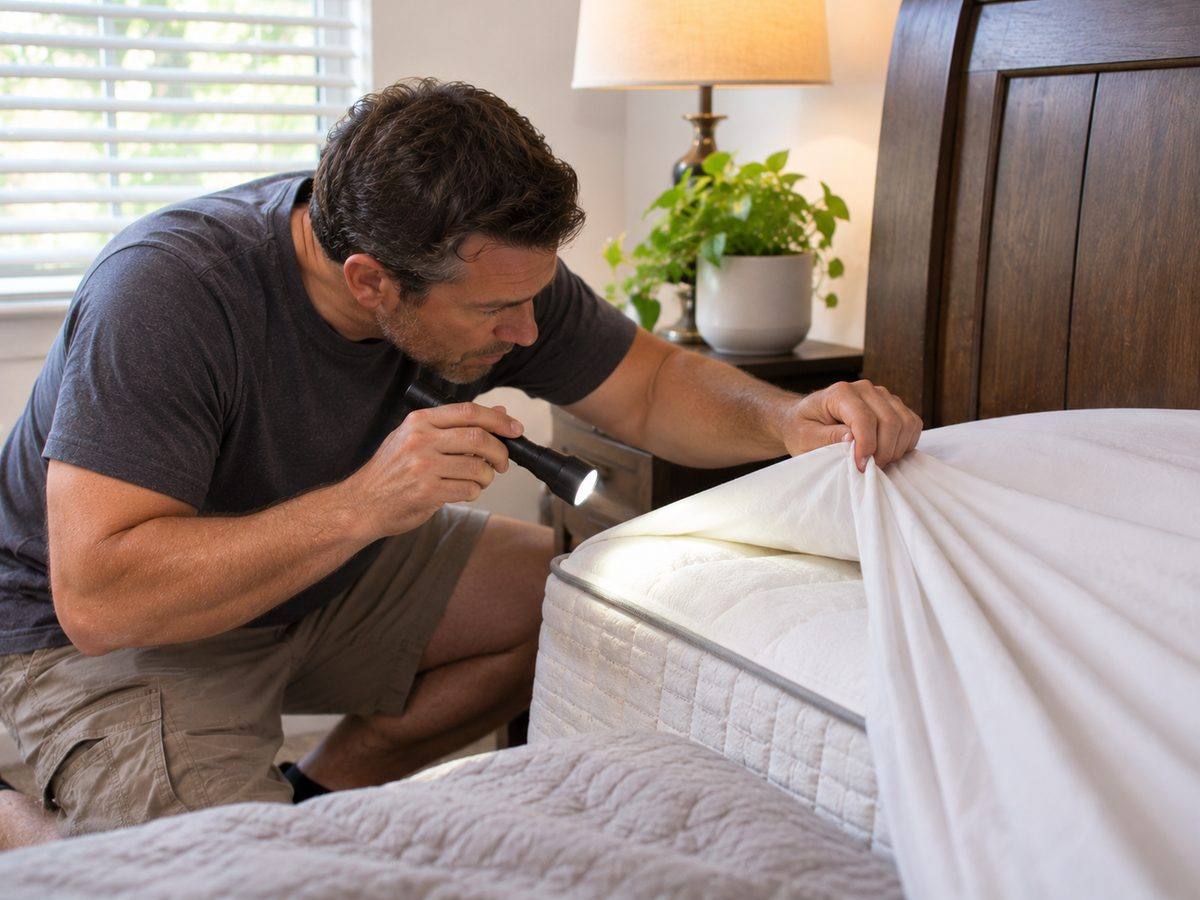
- Where they hide: close to where people sleep or sit for long periods. Mattress seams and piping, the box spring, the back of the headboard, bed frame joints, the bedside table, upholstered chairs and the edges of carpet near the bed.
- What they leave behind: small black or dark brown spots, like dots from a felt-tip marker, on sheets, mattress seams and the headboard; pale shed skins; and sometimes tiny rust-colored smears on bedding.
- How long they wait: bed bugs feed at night and hide during the day, and adults can live for months between meals. An empty room is not a cleared room.
Housekeeping sees every bed between guests, which makes them your best detectors. When they strip a bed, a quick look along the mattress seams at the head end, at the corners of the box spring and along the headboard edge takes less than a minute. Train them to stop and report rather than shake out the bedding or carry linens to the next room. The full checklist is in our article on signs of bed bugs.
One caution for managers: a guest complaint about bites is a reason to look, not proof. Bites look different on different people, and many things cause itchy marks. We confirm bed bugs by evidence: live bugs, fecal spots, shed skins or eggs. Bites alone are not proof. For any health question, a guest should talk to a medical professional.
Why do German roaches show up in kitchens, laundry rooms and breakrooms?
Most Las Vegas cockroaches live outside and wander in. The German cockroach is different: it lives indoors, close to warmth, food and water, and it breeds faster than any other common pest cockroach. It is small, light brown or tan, with two dark stripes on the shield behind its head.
In lodging, it rarely starts in the guest rooms. It starts in the back of the house:
- Kitchens and breakfast areas: under prep tables, behind the dish machine, around the ice machine, inside equipment and near sinks.
- Laundry rooms: warm, humid and often cluttered, with lint, spilled detergent and wet floors around the machines.
- Breakrooms: the staff microwave, the refrigerator gasket, the coffee station and the trash can nobody empties on the weekend.
- Kitchenette rooms and rentals: extended-stay rooms and short-term rentals have full kitchens, and guests leave food out.
German roaches mostly ride in. Delivery boxes, used furniture and appliances, and guest bags carry roaches and egg cases from one place to the next. Each egg case holds about 30 young, and a female makes a new one every few weeks, so a few roaches seen in daylight usually means many more out of sight. In a building with shared walls, they also move between units through plumbing and wiring gaps, the same way they do in apartments. Our article on German roaches in apartments covers how that works.
What about flies and gnats at the drains?
Small flies around a sink, a floor drain or a laundry tub are almost always breeding close by. In a home, gnats usually come from two places: overwatered potted plants and the slime that builds up inside kitchen sink and garbage-disposal lines. Lodging has more of both: lobby plants, breakfast-area sinks, floor drains in the kitchen and laundry, and bathroom drains in rooms that sit empty for days.
Drains are your job, not ours. We do not treat drains. What works is a drain-cleaning regimen to remove the slime where the eggs are laid. We recommend gel drain cleaner, 30 minutes at a time, four days in a row. By the third or fourth day most of the slime and sludge is gone. For lobby plants, water less where the plant allows it, and stir the top of the soil: if gnats rush up, that plant is a source.
Larger flies are a door and trash problem. House flies lay their eggs in warm, wet, rotting material like food waste and garbage, and in Las Vegas summer heat they can go from egg to adult in about a week. Indoor flies nearly always came in from outside, so self-closing doors, screens and a clean dumpster area do most of the work. More on that is on our flies page.
Pigeons on the roof and rodents at the dumpster: what draws them?
The outside of a hotel or motel offers what pigeons and rodents want: shelter, food scraps and water.
- Pigeons roost and nest on flat, sheltered surfaces: rooftop AC units, ledges, signs, parapets, balconies and the shaded spaces under covered walkways. In the desert summer, water is life for pigeons, and they drink from pools and spas. They roost in the deepest shade and shelter. Their droppings foul walkways, cars, pool decks and equipment, and the mess builds fast where a flock settles. Our article on pigeons on AC units and patios covers the roosting spots.
- Roof rats and mice follow the trash. A dumpster with an open lid, bags left beside it, food spilled on the pad and thick plants or palms nearby give rodents food and cover within a short run. Roof rats climb, run the tops of block walls and come in along the roofline. Mice fit through a gap about the size of a dime and settle in storage rooms, laundry rooms and kitchens.
What can managers do between visits?
Treatment works best on a property that gives pests less to live on. These habits cost little and make the biggest difference.
- Make the bed check part of turnover. Seams, box spring corners and headboard at every bed change. Housekeeping reports by room number.
- Have a plan for a suspected room. Take the room out of service, leave the bed and furniture where they are, and bag the linens before they leave the room. Moving a mattress or chair down the hall can spread bed bugs to the next room.
- Keep luggage off the floor and beds. Luggage racks away from the bed and walls give bed bugs fewer places to step off a suitcase.
- Clean behind and under. In the kitchen, laundry and breakroom, clean behind and under equipment where the mop does not reach, and do not leave food out overnight.
- Fix leaks fast. Roaches cannot go long without water, and a drip under a sink or washer is their water fountain.
- Get cardboard out. Unpack deliveries and get the boxes out of the building the same day.
- Run the drains. Put the four-day drain cleaning on the maintenance schedule for kitchen, laundry and floor drains, and run water in empty rooms.
- Manage the trash. Dumpster lids closed, no bags on the ground, the pad rinsed, and bins inside emptied every day.
- Keep a sighting log. Where, when, what and how many. That list tells your technician exactly where to look.
If you manage several buildings or units, our article for property managers and HOAs covers multi-unit properties. If your property runs a restaurant, the restaurant pest control article covers the kitchen in detail.
How Pest Pros does it
Same price as a home. Residential and commercial are priced the same. General service covers more than 100 common pests: $120 for the first service, then $80 every 60 days or $50 monthly. The commercial start-up covers 3,000 square feet inside plus half an acre outdoors. Every commercial quote is custom, built on the same base prices as homes. On general service, if pests return between services, we return at no cost. Every price is on our pricing page.
Bed bugs get a program, not a quick spray. Bed bugs require a program, not a quick spray. We inspect the sleeping and resting areas, treat hiding spots, and follow up to break the cycle. The program is 90 days, 3 services: $100 per room plus $100 per bed for the first visit, then $50 per month. Jobs over 3,000 square feet are a custom quote. Each visit carries a 30-day warranty. The office sends the preparation list before the first visit. The bed bug program explained walks through each visit.
German cockroaches get a program too. The program is 4 visits, a month apart. No contract. It is $200 for the first visit, then $50 for each of the next 3, $350 in all. Every visit treats the full property inside and out, with the focus inside, and each treatment carries a 30-day warranty while you stay on schedule. We treat single units; whole-building German cockroach work is declined by default, and three or more units are a conversation with us. In shared buildings, untreated neighbors can push roaches back in, so long term it is control rather than elimination.
Pigeons. Every pigeon job starts at $300, one story or two, and that includes 15 feet of spike and 30 minutes of cleanup. Anything larger gets a free estimate, done digitally from the address, photos and your description. We do not do pigeon work on 3-story roofs. Details are on our pigeon control page.
Rodents. The rodent program is baiting, not trapping and not sealing: $200 for the first visit with 3 bait stations, then $50 every 30 days, $300 for the complete 3-visit program. Rodent bait is always inside locked, tamper-resistant stations. We are a pest control company, not a repair company, so we do not patch or seal buildings.
How we treat. Licensed technicians apply every product exactly as its label directs, and never on food-contact surfaces. Each warranty covers its own program's pest. Give each treatment 7 days before judging results. Not sure what you have? Instead of a free inspection, we offer a one-time service at $120: general pests treated, and the technician checks the whole property for specialty problems like pigeons, rodents, bed bugs and German cockroaches. There is no contract and no cancellation fee. More is on our commercial pest control page.
Common questions
Do hotels and motels pay more than homes?
A guest says they were bitten. Do we have bed bugs?
How is bed bug treatment priced for a room?
Will you treat our drains for gnats?
Do we have to sign a contract?
Sources: UC IPM Pest Notes: Bed Bugs · US EPA: Bed Bugs · UC IPM Pest Notes: Cockroaches · UC IPM Pest Notes: Flies · UC IPM Pest Notes: Rats · University of Nevada, Reno Extension: Pigeons. Facts are summarized in our own words. Prices, service and warranty come only from Pest Pros.