
Why do bees come to my pool in the summer?
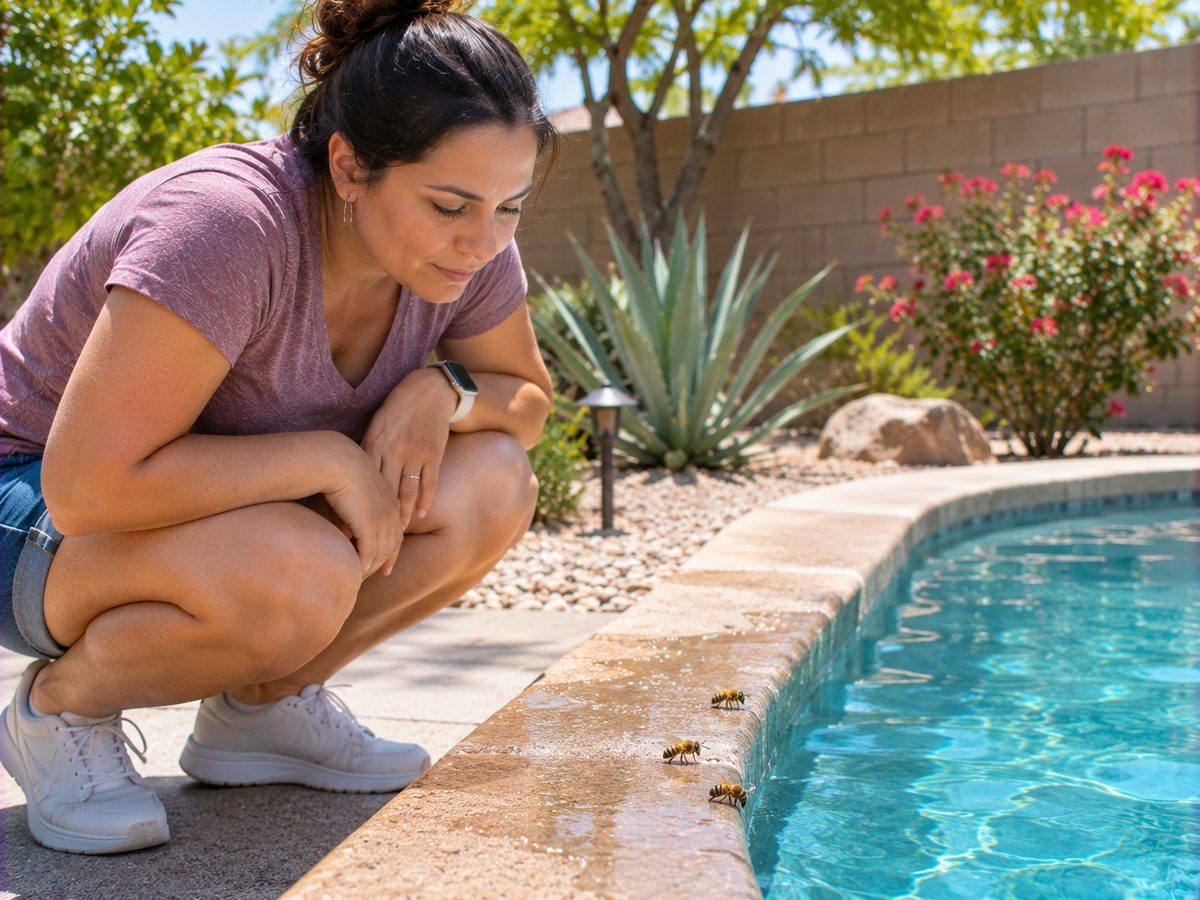
Bees are not at your pool to swim, and in most cases they are not there because of anything you did. They are there for water, and in the Mojave desert in July and August, water is the hardest thing for a colony to find.
The Texas A&M Honey Bee Lab explains that honey bees need water for two reasons. The first is plain hydration, like any animal. The second is air conditioning. When the inside of the hive gets too hot, worker bees bring water home, spread droplets around the comb and fan their wings over them. The water evaporates and pulls heat out of the nest.
That need grows in hot, dry weather, when natural water dries up. In Las Vegas there is very little natural water to begin with, so the dependable sources are in our yards: pools and spas, fountains, birdbaths, pet bowls, drip lines and the puddles a sprinkler leaves behind. Activity in the valley follows heat and water, and late spring through the end of summer is when water-hunting bees are easiest to spot.
There is one more reason bees keep coming back to the same pool. Texas A&M notes that the bees collecting water at your pool tell the rest of the colony where it is. Once a few foragers find a good, reliable water source, more follow them to it. That is why you can go from two bees one day to twenty a week later without anything changing in your yard.
Where do bees drink around a Las Vegas home?
Honey bees are careful drinkers. UC extension apiculturist Eric Mussen, quoted by the UC Agriculture and Natural Resources Bug Squad, describes bees as avoiding getting their feet wet. They do not dive into open water. They stand on something dry and drink from a thin film of water at the edge. So the places to look are wet edges and damp surfaces, not the middle of the pool:
- Pool coping and the waterline tile, especially where splash-out keeps the stone damp.
- The skimmer lid, steps and the rim of a spa, and the top of a water feature or rock waterfall.
- Fountains and birdbaths, where water runs over a lip.
- Pet bowls and water dishes left out on the patio.
- Drip emitters, hose bibs and sprinkler heads that leak or leave a wet patch in the gravel.
- Wet pool toys and floats drifting near the edge, and pool covers that hold a shallow puddle.
Does a steady stream of bees mean there is a hive nearby?
Not always, but it is worth paying attention to. Texas A&M points out that your pool is unlikely to be the only water within the bees' flying range, and bees will travel to reach a good source. A handful of bees at the water may be coming from a colony a block or more away, and there is nothing on your property to find.
The picture changes with numbers and with what you see in the water. The UC Bug Squad article explains that a strong colony raises a large number of new workers every day, and that older foragers keep working until they wear out and drop, sometimes into a pool. In that article, the bees turning up in a homeowner's pool were traced back to a colony living nearby. So daily dead or struggling bees in the pool, on top of a busy crowd at the edges, is a sign that a colony is close.
Here is how to read what you see:
- A few bees, on and off: most likely foragers from somewhere else. Normal for a Las Vegas summer.
- Dozens of bees every hot day, all summer: a colony within flying distance has adopted your water. It could be in your yard, a neighbor's yard, or a wash or open lot nearby.
- Bees floating in the pool or skimmer every day: a strong sign the colony is close.
- Bees flying a straight line from the water to one spot on your house: follow them with your eyes, from a distance. If they disappear into a gap in the stucco, an eave, a roofline, a meter box or a valve box, that is a hive. Read bees in walls and meter boxes for what that means.
- A ball of bees hanging on a branch or fence: that is a swarm, not water traffic. See swarm or hive.
The best time to watch is a hot afternoon, from a shaded spot several feet back or from inside behind a closed slider. You do not need to get close to see which way they leave.
Is it a honey bee or a paper wasp at the water?
Wasps come to water too. Penn State Extension notes that hot, dry weather draws wasps to swimming pools and other water sources, so it is common to see both at the same pool. Telling them apart matters, because the follow-up is different. For the full side-by-side, read bees vs wasps. At the water, these are the quick clues:
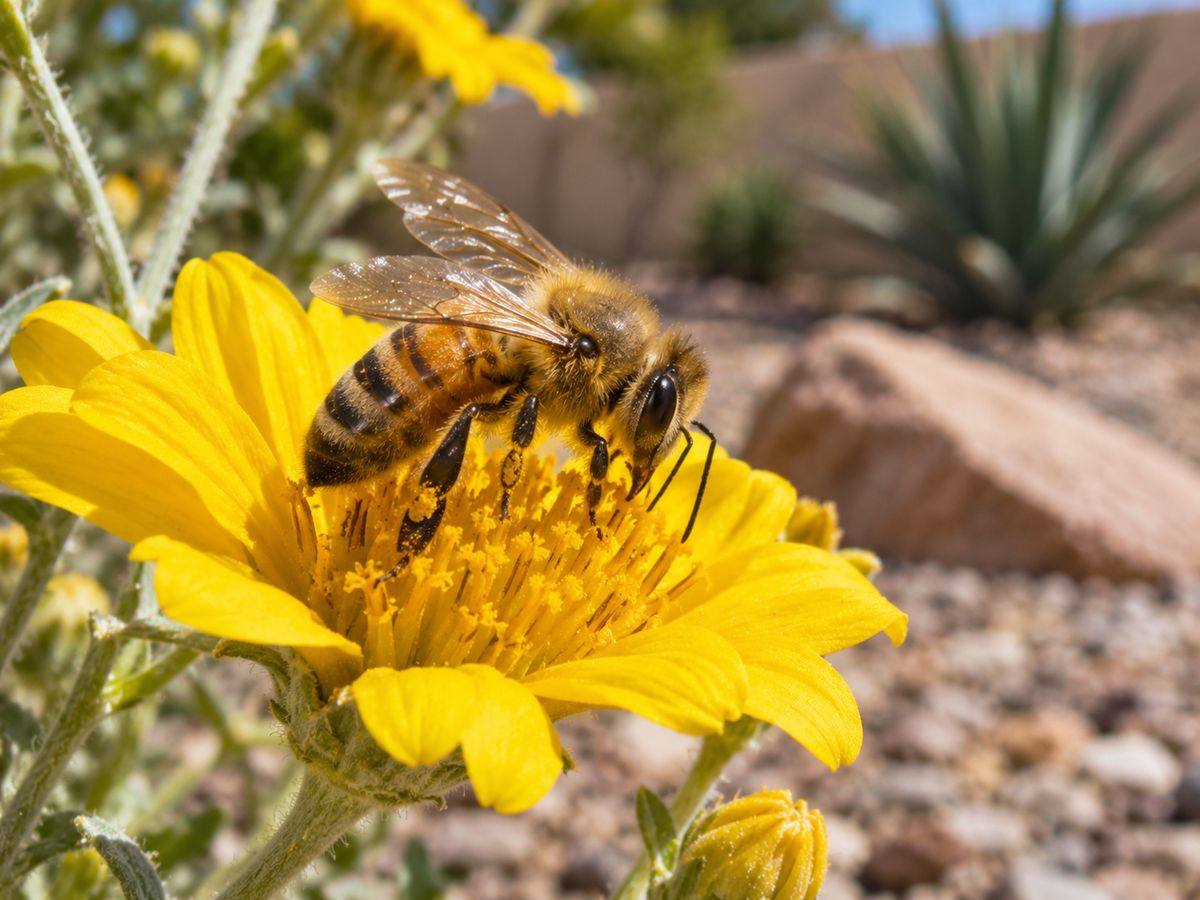
- Honey bee: fuzzy, golden-brown, about half an inch long, with a thick body and no obvious waist. It lands at the edge, drinks, and heads straight back out on the same line. If there is a colony nearby, you will see a lot of them doing the same thing.
- Paper wasp: UC IPM describes paper wasps as slender, about an inch long, with long legs and a distinct narrow waist, usually golden brown or darker with yellow or red markings. The body is smooth and shiny, not fuzzy, and the long legs hang down when it flies.
- Where it goes: bees head off toward a hive that may be far away. Paper wasps often fly back to a small, open, umbrella-shaped paper nest under a nearby eave, patio cover or pool equipment shade. If you find one nest, walk the rest of the roofline; there are often more. Our post on paper wasps under the eaves covers those nests.
If you are not sure which one you have, take a photo from a few feet back and text it to us. A clear shot of one insect at the edge of the water is usually enough to tell.

What can I do about bees at the pool?
Start with what not to do. Do not swat at bees or wasps at the water, and do not spray them. UC IPM's advice if a wasp lands on you is not to swat it or run, but to wait for it to leave or gently brush it away. Penn State Extension's advice near a defensive colony is the same idea: stay calm, do not swat, and walk away quietly.
A few steps from Texas A&M can make your yard a less attractive water stop:
- Fix leaks. Repair dripping hose bibs, leaky faucets and broken drip emitters or irrigation lines. Every wet patch in the gravel is a free drink.
- Cover the pool and spa when you are not using them. A cover cuts off the wet coping and the open water at the same time.
A few more common-sense habits come straight from the facts above:
- Do not pick bees out of the pool by hand. The UC Bug Squad notes that a bee in the water is not necessarily dead and can still sting if bumped or stepped on. Use the skimmer net, and look before you step on a wet deck barefoot.
- Look before you climb out. Check the edge where you put your hands, since that wet coping is exactly where bees land to drink.
- Keep kids and pets back from the busy spots. If bees are crowding one corner, use the other side of the pool until you know where they come from.
- Do not plug or spray a hole the bees fly into. If you follow the line back to your house, leave the opening alone and call us.
If anyone is stung many times, or has any reaction to a sting, call 911 or Poison Control at 1-800-222-1222 right away. We cannot give medical advice; a medical professional should look at any sting concern. For a pet that is stung, call your veterinarian.
When should I call about bees at the water?
A few bees drinking at the pool edge do not need a visit. Watch them for a few hot days. Call or text us when:
- You follow the bees back to an opening in your wall, eave, roofline, block wall, meter box or valve box.
- The numbers keep growing, or bees are in the pool or skimmer every day and you cannot tell where they come from.
- Bees or wasps are crowding a door, a gate, the steps into the pool or a spot where kids and pets play.
- The bees act defensive: bumping into people, following them, or stinging.
- You find a paper wasp nest under an eave, a patio cover or the pool equipment shade.
Scorpions are the other pest that loves a desert pool deck at night. If you are seeing those too, read scorpions around the pool.
How Pest Pros does it
Bees and wasps are specialty work at Pest Pros, handled with an on-site diagnosis. Our line on bees is simple: bees are beneficial, but in a wall or a high-traffic area they become a safety issue. We identify whether it is a swarm or an established hive first, and the technician confirms swarm or established hive on site before treating.
We judge risk by behaviour and location. If bees are defensive near people or pets, safety comes first. We never call bees Africanized from their looks; when behaviour supports it, we call it what it is, a defensive honey bee colony.
Our bee service is sold at the posted price: $200 per hive at ground level or up to 10 feet, and $300 if the hive is over 10 feet, on a ladder, a second story or otherwise elevated. It is one service. When you call, tell us where the bees are going and how high the opening is, and we can give you the price on the phone. For what the price covers, read what bee hive treatment costs, and for how our warranties work, read our warranty answer.
For paper wasps, we treat the nest directly and check the nearby roofline for new starts, because customers usually see one nest and there are often more. See our wasp page for the rest.
Comb cleanup is not included unless it is sold. Technicians wear a bee suit and follow ladder safety every time, and licensed technicians apply every product exactly as its label directs. There is no contract and no cancellation fee. Every price is on our pricing page.
Common questions
Why are bees drinking from my pool?
Does a lot of bees at my pool mean there is a hive on my property?
Should I spray the bees at my pool?
Are the bees in my pool still dangerous?
What does Pest Pros charge for bees?
Sources: Texas A&M Honey Bee Lab: Bee Frequently Asked Questions; UC ANR Bug Squad: Why Are the Bees in the Pool?; UC IPM Pest Notes: Yellowjackets and Other Social Wasps (Pub 7450); Penn State Extension: Getting Rid of Paper Wasps, Yellowjackets, and Other Stinging Insects. Facts are summarized in our own words. Prices, service and warranty come only from Pest Pros.